The fastest way to plan a month of content in advance is to stop planning post by post. Instead, work from one brief that defines your goals, audience and themes, then batch the whole month by task: write all the copy, design all the visuals, schedule everything to a repeatable cadence, and leave a few deliberate gaps for timely posts. Done this way, a month of content becomes one focused effort instead of thirty scattered ones, and publishing stops depending on who happens to have time this week.
This guide walks through that method in full: why weekly planning keeps collapsing, what belongs in a monthly brief, how to batch each type of work, how to stay on-brand across every channel, and where human review and automation fit into a plan you set once.
Why Weekly, Post-by-Post Planning Keeps Breaking Down
Most teams do not lack ideas. They lack a system that survives a busy week. When each post is planned, produced and published on its own, every single piece carries the same hidden overhead:
- Context reset. You re-explain the brand voice, the colours and the rules before you can even start.
- Mode switching. Writing, designing, scheduling and publishing are four different kinds of work, and jumping between them all day is exhausting and slow.
- Decision fatigue. Deciding what to post, where, and when every single time drains the energy you needed to actually make it.
Stacked across several channels, week after week, that overhead is why "we'll post more" quietly becomes "we posted twice this month." The bottleneck is not effort. It is the sheer number of small, repeated decisions standing between an idea and a published post.
Planning a month at once removes most of that overhead in a single sitting. You make the big decisions once, then execute against them.
What a Monthly Content Brief Should Actually Include
The brief is the whole point. Get it right and the rest of the month becomes execution rather than invention. A useful monthly brief is short but specific, and it covers:
- The goal for the month. One clear objective, such as growing awareness of a specific offer or building your social presence, so every post has a job.
- The audience. Who you are talking to and what they care about right now.
- Three to five themes. Recurring topics or angles that carry the month. Themes prevent the blank-page problem because every post slots under one of them.
- The channels in play. Which platforms this content needs to reach, since a blog post, a newsletter and a social caption all draw from the same idea but need different treatments.
- Non-negotiables. Brand voice, colours, must-mention details and anything to avoid.
- A rough cadence. How often you want to publish on each channel, so the calendar has a target to fill.
Notice what is not in the brief: thirty individually written posts. The brief defines the container. Batching fills it.
A quick monthly-brief checklist
- One measurable goal for the month
- Defined audience and their current priorities
- 3 to 5 content themes
- Channels and posting cadence per channel
- Brand voice, colours and rules stated once
- A short list of known dates or events to plan around
How to Batch Design, Writing and Scheduling
Batching means grouping the same kind of work together instead of doing a little of everything, one post at a time. It is the single biggest lever for planning ahead, because it removes the constant mode-switching that makes content feel heavy.
A practical batching order looks like this:
- Batch the ideas first. Using your themes, list every post for the month at headline level. Do not write them yet. Just fill the calendar with titles and angles so you can see the whole shape.
- Batch the writing. Sit down once and write all the copy: captions, the blog post, the newsletter, ad lines. Because you are in a single writing mode, the voice stays consistent and you move far faster than starting cold each day.
- Batch the design. Produce all the visuals together so they share a coherent look. On-brand creative in your colours and grid, not a different style every week.
- Batch the scheduling. Slot everything into the calendar in one pass, matched to the cadence you defined in the brief.
The gain is compounding: each mode gets easier the longer you stay in it, and the finished month is more consistent because it was made as a set, not a series of one-offs.
This is where an end-to-end system changes the maths. If you are still coordinating four separate tools and handoffs, batching only goes so far. We unpacked that coordination trap in Your Marketing Stack Is Scattered. An Operating System Fixes It.
Keeping a Month of Content On-Brand Across Channels
The risk with planning ahead is drift. When a month of content is made in bursts, or by different people, small inconsistencies creep in: a slightly different tone here, an off-brand colour there. Over thirty posts, that drift becomes visible, and for a premium brand it is exactly what you cannot afford.
The fix is to define the brand once and let every piece inherit it, rather than re-deciding brand rules on each post. Practically, that means:
- Lock voice and visual rules in the brief, then treat them as fixed for the whole month.
- Adapt, don't reinvent, per channel. One idea becomes a long-form blog post, a shorter newsletter section and a punchy social caption. Same substance, channel-appropriate format.
- Review the month as a set. Look at all the visuals side by side and all the copy together. Inconsistencies are obvious in a batch and invisible one post at a time.
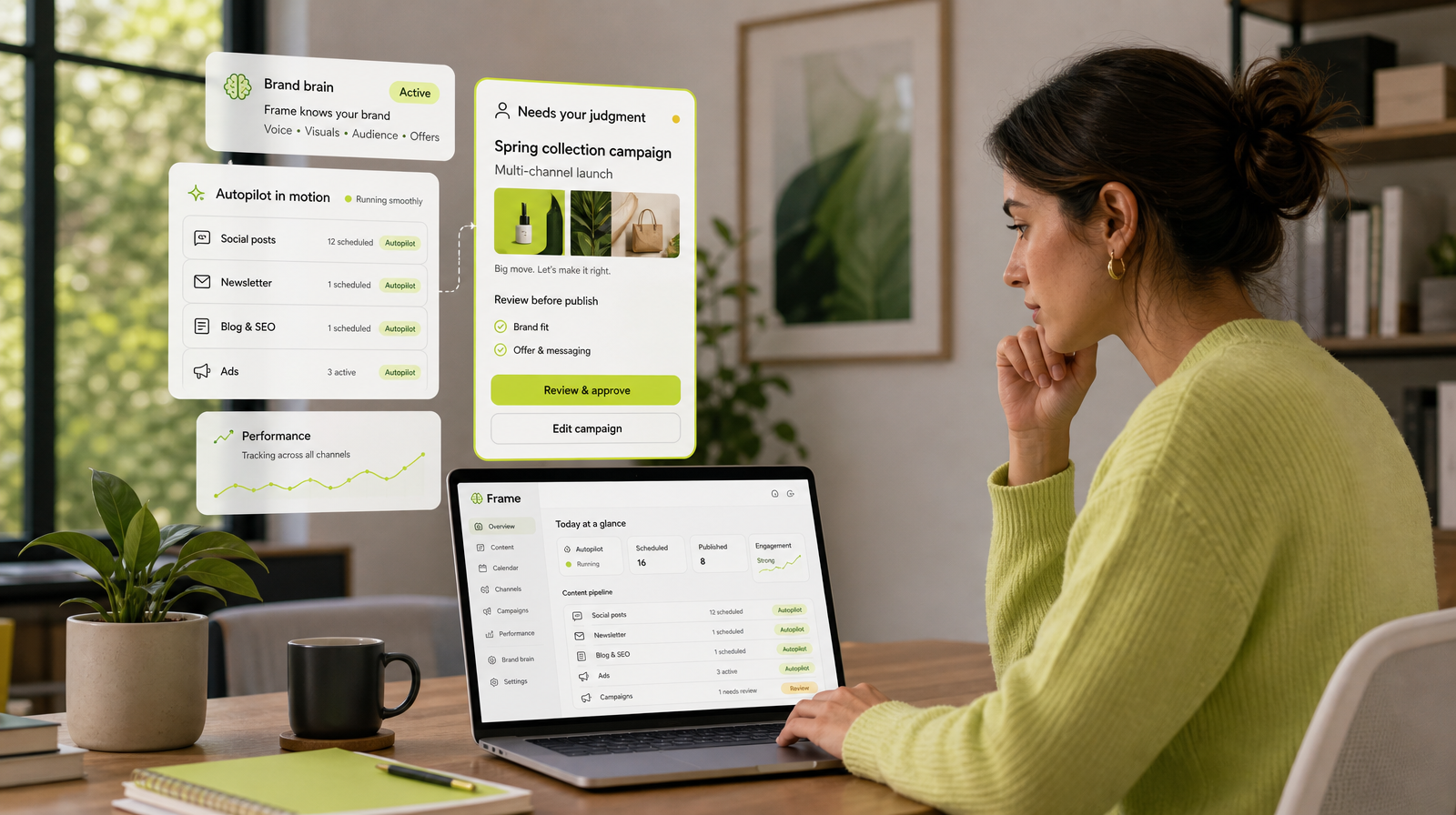
This is the core idea behind how Frame works: it learns your brand once, saving your voice, colours and rules as active brand memory. New work opens from that context instead of a blank prompt, so a month of content stays recognisably you across social, newsletters, blog and SEO. One brief in, a coordinated month out.
Where Human Review and Automation Fit
Planning ahead does not mean losing control. The best pre-planned month keeps human judgment exactly where it matters and automates the parts that only need to be reliable.
A workable split looks like this:
- Humans decide the direction. The brief, the themes and the final approval on anything sensitive stay with you.
- Automation handles the grind. Generating first drafts, laying out visuals to brand, slotting posts across time zones and cadences, and publishing on schedule are all repetitive work that does not need a person every time.
Frame is built around this human-in-the-loop model. You can review and approve the work that needs your call, or let Autopilot keep routine content moving. Either way, a month of content can be scheduled where your audience actually is, with time zones, send times and cadence handled for you, rather than published whenever someone is still online.
If you want the fuller argument for automating without sacrificing brand control, we covered it in Automate Marketing Without Losing Control of Your Brand.
Leaving Room for Timely and Reactive Posts
A common fear is that planning a month ahead makes you rigid, unable to respond to something happening now. The answer is to plan the gaps deliberately.
- Aim to pre-plan roughly 80 percent of the month. That is the evergreen, on-brand content that does not depend on the news.
- Leave open slots in the calendar, clearly marked, for timely or reactive posts.
- Keep a small "quick-turn" template ready, matched to your brand rules, so a reactive post still looks like the rest of the month rather than something you rushed.
Pre-planning the bulk actually creates room to be spontaneous, because you are not scrambling to fill the baseline. The reactive posts sit