The phrase "AI marketing" has lost its meaning. Ask ten marketers what it means to them, and you will get ten different answers. One thinks of a chatbot that drafts captions. Another thinks of an image generator that turns text prompts into graphics. A third thinks of a scheduling tool that automatically posts to social media at optimal times.
None of these are wrong. But none of them are an operating system.
An operating system does something fundamentally different from a tool. A tool performs a task. An operating system manages memory, coordinates execution, and provides a unified layer through which all work flows. Your computer's operating system does not just open files; it remembers where they are, manages the resources required to open them, and ensures that your browser, your email client, and your design software can coexist without crashing each other.
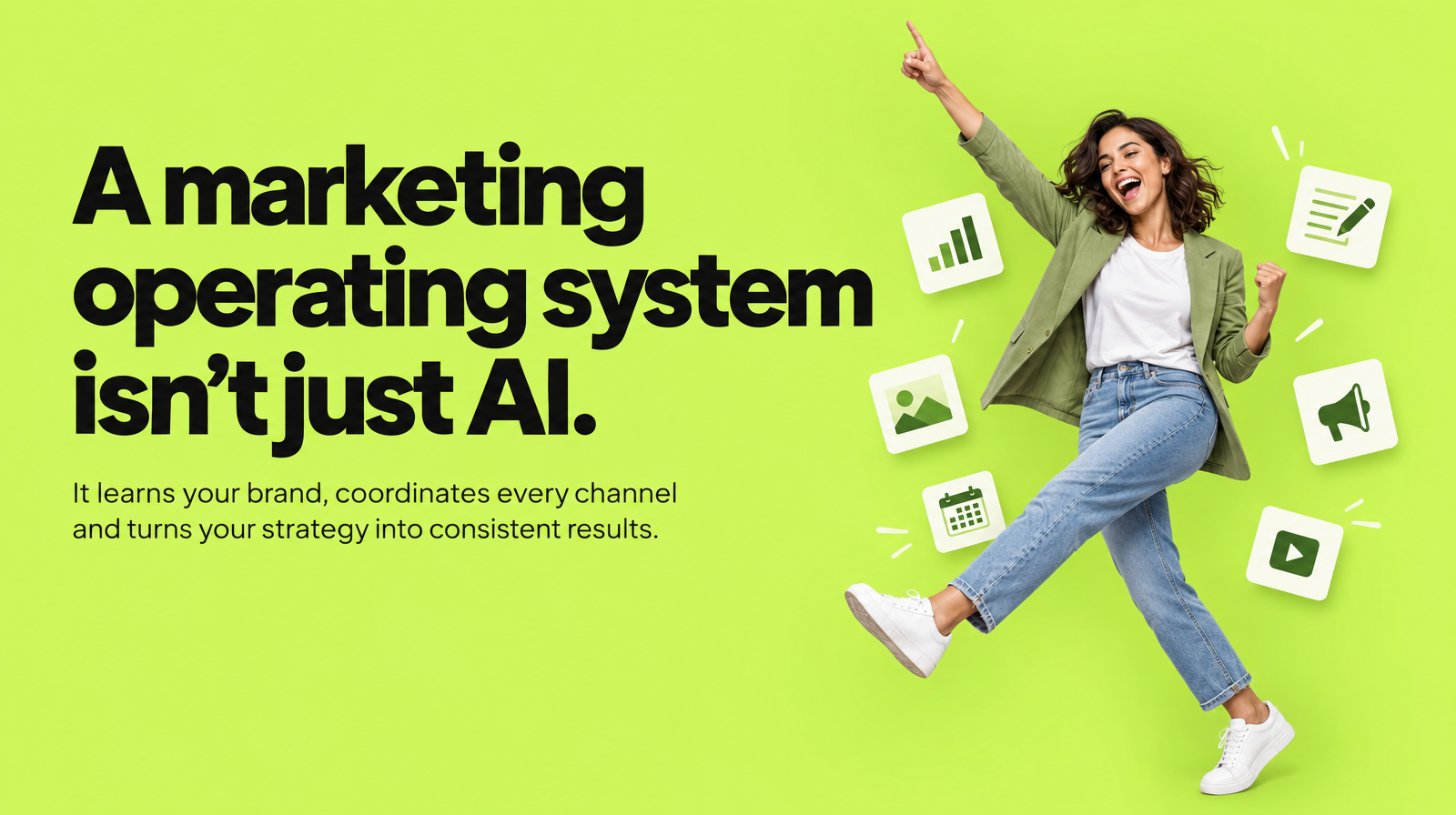
A marketing operating system does the same thing for your marketing. It learns your brand once — your voice, your colours, your standards — and then coordinates the design, writing, scheduling and publishing of content across every channel, with your approval or on Autopilot.
If your team is evaluating AI marketing solutions, understanding the difference between a tool and an operating system is the most important decision you will make. It determines whether you are adding another subscription to a fragmented stack, or replacing the stack entirely.
The Problem With Adding Another Tool
Most marketing teams do not realise they have a coordination problem until they count the tools. A typical marketing stack looks like this: a design tool for visuals, a copywriting tool for captions, a social media scheduler, a separate platform for email newsletters, a blog CMS, an SEO plugin, and an ads manager. Each tool performs its function. But the team becomes the operating system. The team carries the brand context from tool to tool. The team translates the campaign direction into each tool's format. The team coordinates the timing, the cadence, and the publishing across every platform.
Adding an AI tool to this stack does not solve the coordination problem. It simply adds another tool that the team must manage. A caption generator that does not know your brand voice is just a faster way to produce off-brand content. An image generator that does not know your colour palette is just a faster way to produce inconsistent visuals.
The result is the same friction, at a slightly faster speed.
What Makes a Marketing Operating System Different
A marketing operating system is not a tool that performs a single task. It is a layer that manages three things: memory, execution, and coordination.
1. Memory: Learning Your Brand Once
The first thing an operating system does is remember. When you set up your computer, you configure your preferences once. Your wallpaper, your default browser, your language, your notification settings. The operating system remembers these preferences and applies them across every application you open.
A marketing operating system does the same thing with your brand. Frame learns your brand once — your voice, your colours, your fonts, your grid, your standards. This is not a prompt that you paste into a chat window every time you need content. It is a learned foundation that the system applies to every piece of content it generates, across every channel.
This is a critical distinction. A tool asks you to re-explain your brand every time you use it. An operating system asks you once, and then carries that context into everything it produces. A generic AI tool can generate a caption. A marketing OS generates a caption that sounds like your brand, on a good day, every day, including the bad ones. It generates a design in your colours, your fonts, your grid — not "AI art." The memory is the foundation. Without it, you are just producing content faster, not better.
2. Execution: The End-to-End Content Lifecycle
The second thing an operating system does is execute. But it does not execute a single task. It manages the entire lifecycle of a process.
Think about how your computer's operating system manages a file. It does not just create the file. It saves it, organises it, retrieves it when you need it, and ensures it is compatible with the application you want to open it in. The operating system manages the file's entire lifecycle, from creation to retrieval.
A marketing operating system manages the entire content lifecycle. Frame's verified workflow includes four stages: design, write, schedule, publish. These are not separate tools. They are stages in a single, connected process.
- Design: Frame creates on-brand visuals in your colours, your fonts, your grid. Feed it one product shot, get a campaign back.
- Write: Frame generates captions, newsletters, blog posts, and ad copy. The Copy Engine produces content that sounds like your brand, not like a chatbot.
- Schedule: Frame slots content into a calendar based on your audience's time zones, send times, and cadence. A month of content, arranged where your audience actually is.
- Publish: Frame pushes content live across every channel and provides the analytics to measure results, without opening ten dashboards.
The key difference is that these stages are connected. A tool performs one stage and hands off to the next tool. An operating system carries the work through all four stages without losing context. The brief that defines your campaign goals is the same brief that informs the design, the copy, the schedule, and the publication. No handoffs. No lost context. No rebuilding the work for every channel.
3. Coordination: One Brain Across Every Channel
The third thing an operating system does is coordinate. Your computer's operating system ensures that your browser, your email, and your design software can run simultaneously without conflicting. It allocates resources, manages priorities, and ensures that everything works together.
A marketing operating system coordinates your presence across every channel. Frame supports social content (Instagram, TikTok, LinkedIn, X, YouTube, Facebook), ads, newsletters, blog, and SEO. These are not separate integrations that you must configure and maintain. They are channels that the system coordinates from one learned brand foundation.
This coordination is what makes the operating system concept real. When you have a campaign direction, the system does not just generate a social post. It generates a coordinated set of content across social, ads, newsletters, blog, and SEO — all sharing the same brand voice, the same colours, the same typographic rhythm. One brief becomes a month of content. Every channel, one pass.
Without coordination, each channel becomes a separate production job. The social post is designed in one tool. The newsletter is written in another. The blog is drafted in a third. The ad copy is created in a fourth. The team spends more time translating the campaign direction into each tool's format than they spend on the campaign direction itself.
A marketing OS eliminates that translation work. The system carries the direction through every channel, maintaining consistency and reducing the production work to a single review.
Control: Human Approval or Autopilot
There is a fourth characteristic of a marketing operating system that is often overlooked: control. An operating system does not remove you from the process. It gives you a choice about how involved you want to be.
Your computer's operating system lets you open applications manually, or you can set applications to launch at startup. You can manage your files by hand, or you can let the system organise them automatically. The operating system provides the infrastructure; you decide how much control to retain.
Frame does the same thing for marketing. The system supports two modes: human approval and Autopilot.
In human approval mode, Frame generates the content, and your team reviews it before it goes live. You can approve, refine, or reject. The system handles the production work; your team handles the judgment. This is the mode that most teams start with, because it builds trust. You see exactly what the system produces, in your brand voice, before it reaches your audience.
In Autopilot mode, Frame handles the repeatable production work without requiring your review for each piece. This is not the same as setting a tool to "auto-post." Autopilot means the system is generating, scheduling, and publishing on-brand content across every channel, based on the brand foundation it has learned. It is the equivalent of setting your operating system to manage routine background tasks while you focus on higher-priority work.
The point of a marketing OS is not doing marketing all day. It is giving lean teams the infrastructure to keep every channel moving without manually pushing every piece of content through a fragmented stack.
Why the OS Approach Saves More Time Than Adding Another Tool
When you add another tool to your stack, you are adding a new interface to learn, a new login to manage, and a new step in your workflow. You might save time on the specific task the tool performs, but you lose time on the coordination required to integrate that task into the rest of your marketing.
When you adopt a marketing operating system, you are replacing the fragmented stack with a single, opinionated layer. Frame learns your brand once, then handles the design, writing, scheduling and publishing across social, ads, newsletters, blog and SEO. The time you save is not just the time spent writing a caption or designing a graphic. It is the time spent translating your campaign direction into each tool's format. It is the time spent coordinating the timing and cadence across channels. It is the time spent carrying your brand context from one tool to the next.
A marketing operating system does not just make your marketing faster. It makes it more consistent, more coordinated, and more sustainable for lean teams. It replaces the fragmented stack with a single layer that manages memory, execution, and coordination — so your team can focus on the decisions that actually move the business forward.