
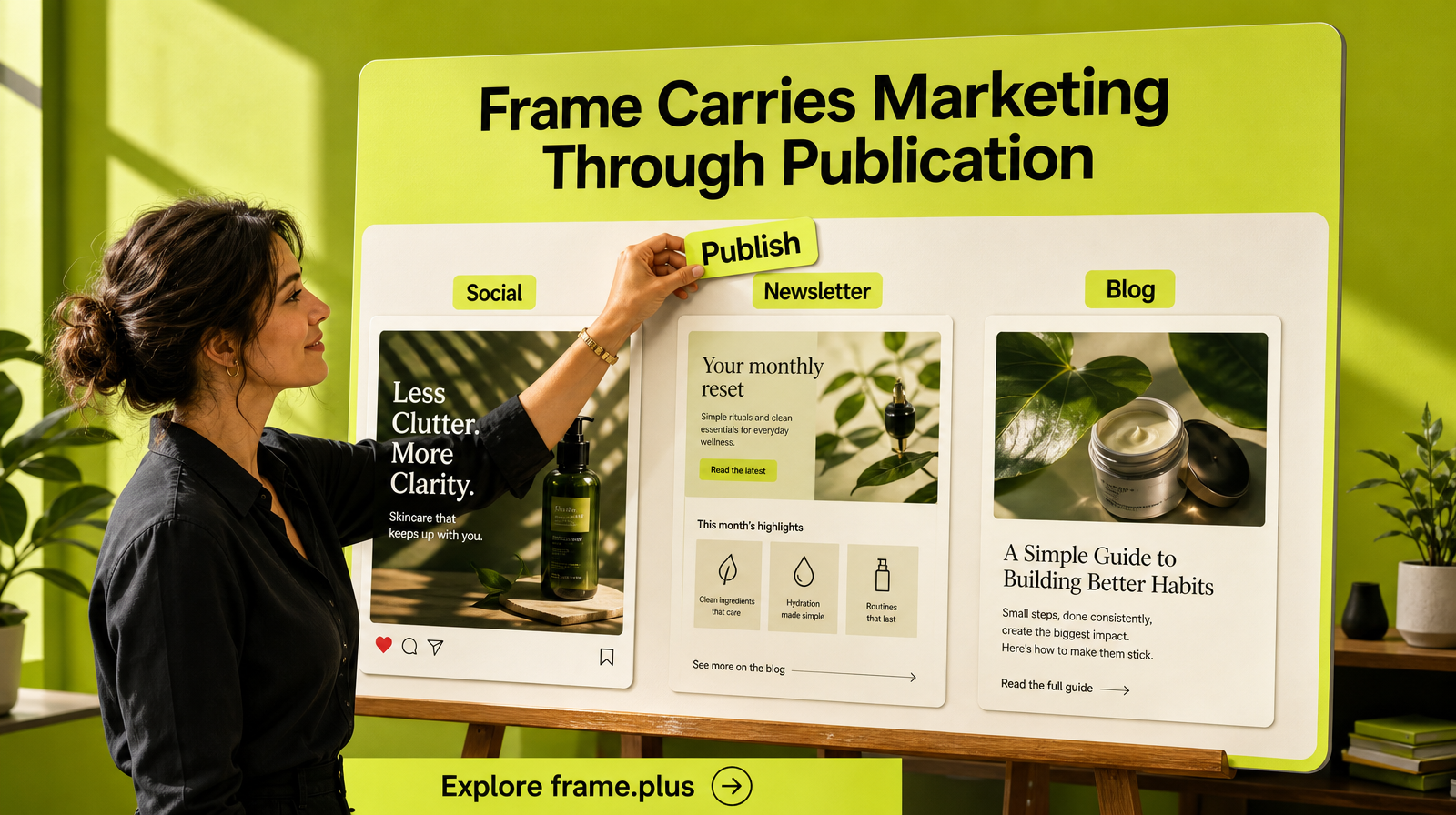
Automate your marketing in this order: scheduling and publishing first, repurposing and production second, copy and design drafting third — and keep strategy, positioning and final approval human until the system has earned your trust. The rule of thumb is simple: automate tasks that are repetitive, rule-based and low-judgement before anything that carries brand risk. Get the order wrong and you don't get leverage; you get faster chaos.
That distinction matters more now than it did a year ago. Organisations across every sector are actively drawing the line between where AI automation belongs and where human control must remain — Deloitte's 2026 Global Technology Leadership Study describes technology leaders operating with an AI-first agenda but an expanded mandate for governance and judgement alongside it. Marketing teams face the same question at a smaller scale: not whether to automate, but what first.
Here's a practical way to answer it in one sitting.
The Triage Test: Three Questions Per Task
List every recurring marketing task your team touches in a month — typically fifteen to thirty of them. Then score each one against three questions:
- How often does it repeat? Daily and weekly tasks repay automation fastest. A task done twice a year barely matters.
- How much judgement does it require? Does the task have a right answer that follows from rules (correct format, correct time, correct channel), or does it require taste, context and accountability?
- What's the brand risk if it goes wrong? A mis-timed post is embarrassing for a day. A wrong claim in an ad or a broken brand voice can cost far more.
The tasks that score high repetition, low judgement, low risk are your first automation candidates. Tasks scoring the opposite stay human — for now, and in some cases, always.
Tier 1: Automate First — Scheduling, Publishing and Distribution
This is the safest starting point, and the one small teams most often postpone.
Scheduling and publishing are pure logistics. The decision ("this content should go out on these channels") has already been made by a human. Everything after that decision — slotting posts into a calendar, hitting publish across six platforms, formatting for each channel's constraints — is mechanical work with a verifiably correct outcome.
If your team is still manually copying a caption into five different apps every morning, that is hours of skilled attention spent on work with zero creative content. It's also where consistency quietly dies: the newsletter goes out "when someone remembers," and someone rarely remembers.
Automate: content calendars, cross-channel publishing, send-time selection, time-zone handling, UTM and formatting conventions.
Keep human: what gets published at all.
Tier 2: Automate Next — Repurposing and Production
Once distribution runs itself, the next bottleneck is production volume. This is where repurposing earns its keep.
Repurposing is rule-based work: a blog article becomes three social posts, a newsletter section and a script outline. The source material already contains the judgement; the task is faithful transformation, not invention. That makes it a strong second candidate — especially for teams suffering from the channel coverage gap, where social stays alive while newsletters, blogs and SEO slip because there's no time to re-cut one idea for every channel.
The same logic applies to design production at the execution level: resizing creatives, applying brand colours and grids, generating variants from an approved master. The design decision is human. The hundred mechanical applications of it are not.
Automate: turning one asset into many, applying brand systems to new content, producing format variants.
Keep human: the original creative concept and anything a customer would screenshot.
Tier 3: Automate With Oversight — Drafting Copy and Design
Should a small team automate scheduling before content creation? Usually, yes — and this tier is why. Drafting is the highest-leverage automation but also the one that fails worst without the first two tiers in place.
AI can draft captions, newsletters, blog posts and ad copy fast. The question is whether it drafts in your voice or in a generic one. Teams that jump straight to automating creation — before the brand is captured anywhere a system can use it — end up spending their saved hours editing tone back into everything. That's why brand consistency is fundamentally a memory problem: the drafting only stays on-brand if the system carrying out the drafting already holds the brand.
The fix is sequencing. Capture the brand once — voice, colours, audience, the words you never use — then automate drafting against that foundation, with a human approving before anything ships.
Automate: first drafts of recurring copy, on-brand creative generation from source material, SEO and blog outlines.
Keep human: final approval on everything public-facing, plus anything that makes a claim.
What Should Always Stay Human
Some decisions should never be automated, no matter how good the tooling gets:
- Positioning and strategy. What you stand for, who you're for, what you refuse to say. These are accountability decisions, and accountability can't be delegated to software.
- Sensitive communications. Anything responding to a crisis, a complaint or a charged moment requires human reading of the room.
- Claims and commitments. Prices, results, partnerships, legal or medical statements. A human must own every factual promise the brand makes.
- The approval decision itself — until you choose otherwise. Automation should propose; a person should dispose, at least at the start.
This isn't a limitation of the technology. It's the correct division of labour: machines carry repetition, humans carry judgement.
When Does Autopilot Make Sense?
The move from human approval to full autopilot should be earned, not assumed. A sensible graduation test:
- Run approval mode for a full content cycle — at least a month. Track how often you actually change what the system produces.
- If you're approving 90%+ untouched, your review is ceremonial. That's the signal autopilot is safe for that category of work.
- Graduate by task, not globally. Routine social scheduling might go autopilot while newsletters and ads stay approval-gated. The risk tiers above still apply.
Autopilot is a conclusion you reach from evidence, not a starting position.
How Frame Approaches the Same Order
This triage isn't theoretical for us — it's how Frame, the AI marketing operating system, is structured. Frame learns your brand once, then automates the workflow in the order this article recommends: scheduling and publishing handled end-to-end, one brief repurposed across social, ads, newsletters, blog and SEO, and copy and design drafted against the stored brand rather than from a blank prompt. Approval stays in your hands by default; Autopilot is a switch you flip deliberately, per your own graduation test. If you're weighing that order for your team, how to choose an AI marketing operating system covers the evaluation criteria in more depth — and you can test the whole loop on Frame's 7-day free trial, every feature, no card required.
A 30-Minute Starting Exercise
This week, do the triage for real:
- List your recurring marketing tasks.
- Score each on repetition, judgement and brand risk.
- Circle the top three that are frequent, rule-based and low-risk.
- Automate those first — and only those.
The goal was never to automate marketing. It's to remove the grunt work so the humans you have spend their hours on the decisions only humans can make. Start where the risk is lowest and the repetition is highest, keep approval where the brand is at stake, and let everything else earn its automation.
Further reading: